BCD / Punched Card Translator
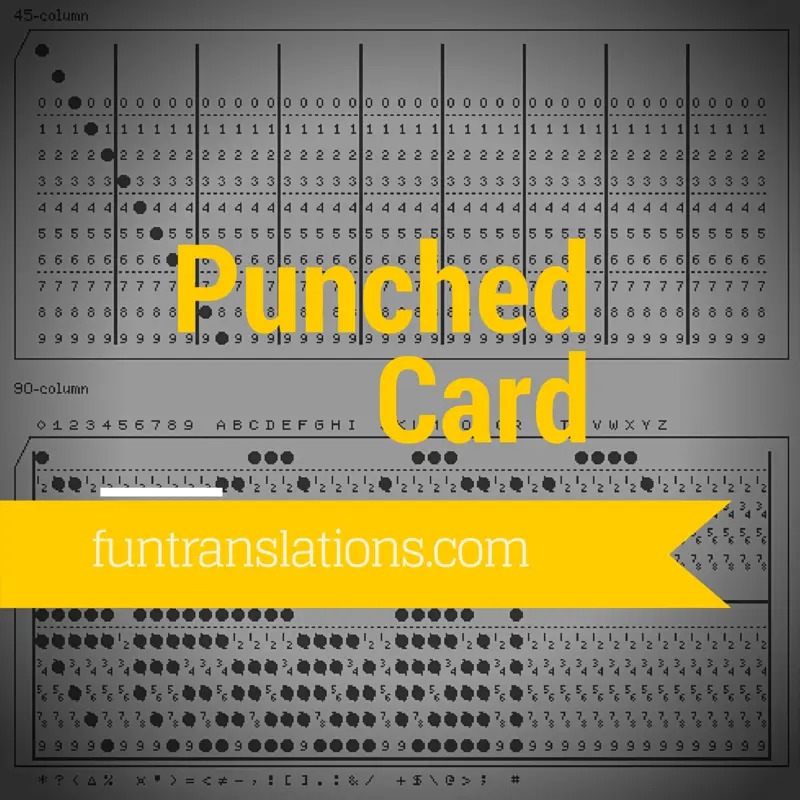
Convert from English to BCD / Punched Card. A punched card, punch card, IBM card, or Hollerith card is a piece of stiff paper that contained either commands for controlling automated machinery or data for data processing applications. Both commands and data were represented by the presence or absence of holes in predefined positions.
Enter some text and click Translate to see the result
What Is BCD Punched Card Encoding?
BCD (Binary-Coded Decimal) punched card encoding is a system for representing data on physical punched cards using binary-coded decimal notation — a method in which each decimal digit (0-9) is represented by a four-bit binary pattern. Punched cards encode data by punching holes in specific positions on a physical card; card readers detect the presence or absence of holes to recover the original data. BCD punched cards were fundamental to the early history of computing, serving as the primary data input medium for mainframe computers from the 1950s through the 1970s.
The standard 80-column IBM punched card — introduced in 1928 and remaining dominant for decades — used a twelve-row grid with 80 columns. Characters were encoded by combinations of hole punches in specific rows of each column. The Hollerith code (named after Herman Hollerith, who invented the punched card for the 1890 US Census) and later IBM BCD encoding schemes mapped letters, numbers, and symbols to specific hole patterns, allowing complex data to be stored on physical cards that could be sorted, batched, and read by mechanical and later electronic equipment.
The Punched Card Era
Punched cards dominated data processing for most of the 20th century. Herman Hollerith developed the concept for the 1890 US Census, reducing the processing time from 8 years (for the 1880 census) to just 1 year. He founded the Tabulating Machine Company in 1896, which eventually became IBM in 1924 through a series of mergers. IBM's domination of the punched card market — controlling not just the equipment but the cards themselves — shaped the early computer industry.
The phrase "Do not fold, spindle, or mutilate" became a cultural touchstone of the 1960s — appearing on punched cards as an instruction but becoming a symbol of the era's growing unease with technological dehumanisation and IBM's corporate power. Free Speech Movement protesters at UC Berkeley in 1964 adopted the phrase as a rallying cry for human dignity against the machine. Punched cards were finally displaced by magnetic tape, disk storage, and interactive terminals during the 1970s and 1980s, though they continued in some specialised uses into the 1990s.
BCD Encoding Reference
BCD binary representations for decimal digits:
| Decimal | BCD (4-bit) | Decimal | BCD (4-bit) |
|---|---|---|---|
| 0 | 0000 | 5 | 0101 |
| 1 | 0001 | 6 | 0110 |
| 2 | 0010 | 7 | 0111 |
| 3 | 0011 | 8 | 1000 |
| 4 | 0100 | 9 | 1001 |
Legacy and Historical Significance
The punched card's legacy extends far beyond its physical technology. The 80-column width of early computer terminals and the persistence of 80-character line lengths in programming conventions (still evident in many style guides today) directly traces to the dimensions of the IBM 80-column card. Computer science education itself was shaped by the punched card era — the batch processing model, where users submitted jobs and waited for results, defined how people thought about computing for decades.
Punched cards also shaped software culture. Programming on cards required precision — a misplaced hole meant a rejected job and a wasted day. This physical immediacy of errors, and the experience of carrying your program as a stack of physical cards, created a relationship between programmer and code that is qualitatively different from modern interactive development. Retrocomputing enthusiasts and computer history museums preserve punched cards and the equipment that read them as tangible artefacts of computing's physical origins.
How This BCD Punched Card Translator Works
This BCD punched card translator encodes text into BCD punched card representation — converting characters into their binary-coded decimal equivalents as they would appear in the punched card encoding systems used in mainframe computing.
Perfect for computing history enthusiasts, retrocomputing fans, students learning about early data encoding methods, or anyone who wants to experience the data representation schemes that powered the first decades of the computer age. Do not fold, spindle, or mutilate.