Shakespeare translator
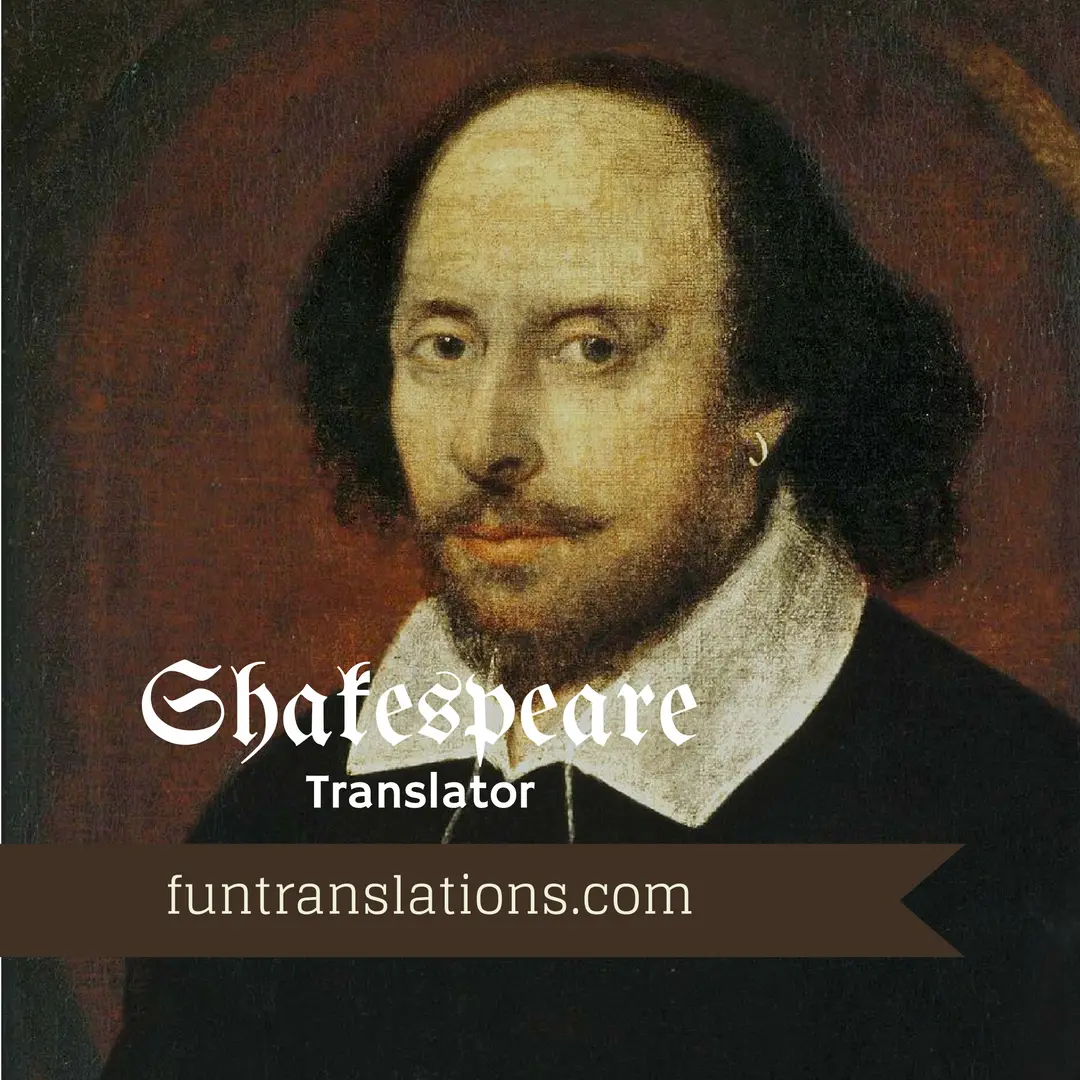
Convert from English to Shakespeare. Shakespeare invented many words and his style of narration in many ways was unique to his time. His ever popular works ( dramas and poems ) makes his language style live even today. This translator takes English as input and converts to Shakespeare English.
Enter some text and click Translate to see the result
Shakespeare-english Translator API Available
Integrate this translator into your app or workflow. Starting at $4.99/month
What Is Shakespearean English?
Shakespearean English refers to the Early Modern English spoken and written in England roughly between 1500 and 1700 — the era of William Shakespeare (1564–1616). It is characterised by its distinctive pronoun system (thou, thee, thy, thine for informal singular "you"), archaic verb conjugations (dost, hast, art), and a rich vocabulary of words that have since fallen largely out of everyday use.
Shakespeare wrote in a period of enormous linguistic creativity. English had not yet been standardised — spelling was fluid, vocabulary was expanding rapidly through Latin and French borrowings, and playwrights experimented freely with grammar and word formation. Shakespeare himself coined or popularised over 1,700 words we still use today, including "bedroom", "uncomfortable", "generous", "lonely", "obscene", and "eyeball".
Key Differences from Modern English
Several grammatical features make Shakespearean English immediately recognisable. The thou/you distinction carried social weight: thou was used for intimacy, social inferiors, or in prayer; you was formal and respectful. Using thou to a social superior was a deliberate insult — a detail that appears in several Shakespeare plays as a pointed provocation between characters.
Verb forms also differ: "you are" becomes "thou art", "you have" becomes "thou hast", "you do" becomes "thou dost". The suffix -eth (as in "he speaketh") was the third-person singular present tense marker, gradually being replaced by -s ("he speaks") during Shakespeare's own lifetime. Both forms appear side by side in his plays, reflecting the language in transition.
Famous Shakespearean Phrases
Many phrases we use today originated with Shakespeare. Here are iconic quotes and their modern equivalents:
| Shakespearean | Modern English |
|---|---|
| To be, or not to be | Should I live or die? |
| What's in a name? | Names don't define things. |
| All the world's a stage | Life is like a performance. |
| Et tu, Bruté? | Even you, Brutus? (the sting of betrayal) |
| The lady doth protest too much, methinks | She's overdoing her denials. |
| Hark, what light through yonder window breaks? | Listen — what is that light in the window? |
| Brevity is the soul of wit | Saying less is smarter. |
| Parting is such sweet sorrow | Goodbye is both sad and tender. |
Shakespeare's Lasting Influence on English
Shakespeare's influence on the English language is unparalleled. He coined phrases still in daily use: "break the ice", "wild goose chase", "heart of gold", "green-eyed monster", "foregone conclusion", "in a pickle", and hundreds more. Some constructions that sound "old-fashioned" today were in fact innovations he introduced that subsequently became standard.
His 37 plays and 154 sonnets remain among the most studied literary works in the world, performed in every country and translated into every major language. Shakespeare's works are a primary source for historical linguists studying the transition from Middle to Modern English, and they contain some of the earliest recorded uses of hundreds of common English words and expressions that are now considered entirely ordinary.
How This Shakespeare Translator Works
This English to Shakespearean translator converts modern English into Early Modern English by substituting contemporary vocabulary and pronouns with their Elizabethan equivalents. "You" becomes thee or thou, "are" becomes art, "have" becomes hast, and modern words are replaced with period-appropriate synonyms wherever possible.
Enter any modern phrase and see how Shakespeare — or his contemporaries — might have expressed it. Whether for academic interest, theatrical performance, creative writing, or simply to confuse your friends, this translator brings a touch of Elizabethan eloquence to your modern words. Hark thee well, good traveller!