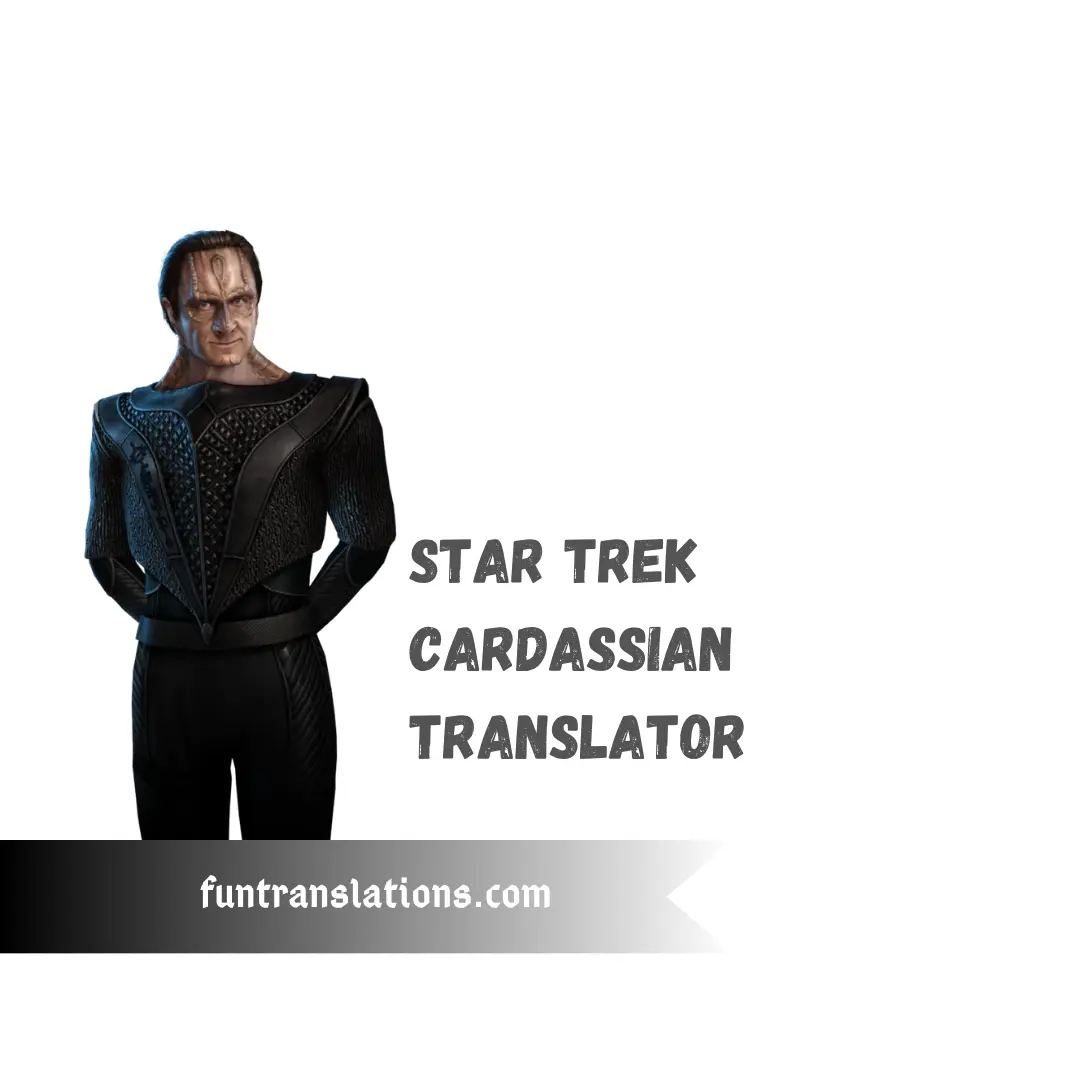
Star Trek Cardassian Kardasi Language Translator
Translate English into Kardasi, the language of the Cardassians from Star Trek: Deep Space Nine and Star Trek: The Next Generation. Uses the comprehensive English-Kardasi dictionary (v0.6.1) by Vyc and tinsnip, covering 300+ canonical words — from salmakt (hello) and ThIjuk (goodbye) to lo'neUnt (strength) and turessin (thank you) — plus authentic Kardasi phoneme rules for unknown words.
Enter some text and click Translate to see the result
What Is the Kardasi Language?
Kardasi is the constructed language spoken by the Cardassians in the Star Trek universe — a proud, militaristic civilisation from the planet Cardassia Prime (Kardasia). The language has been developed collaboratively by dedicated fans and scholars of Star Trek linguistics, with the most complete publicly available resource being the English-Kardasi Dictionary compiled by Vyc and tinsnip.
Kardasi is characterised by harsh consonant clusters, strategic use of apostrophes to mark syllable breaks, and a distinctive orthography that capitalises certain mid-word phonemes — such as the vowels U and I and the digraphs Ch and Th — to represent sounds that have no English equivalent. The result is a language that feels both alien and militarily precise, perfectly suited to the Cardassians' reputation for intelligence and discipline.
Cardassian Language in Star Trek
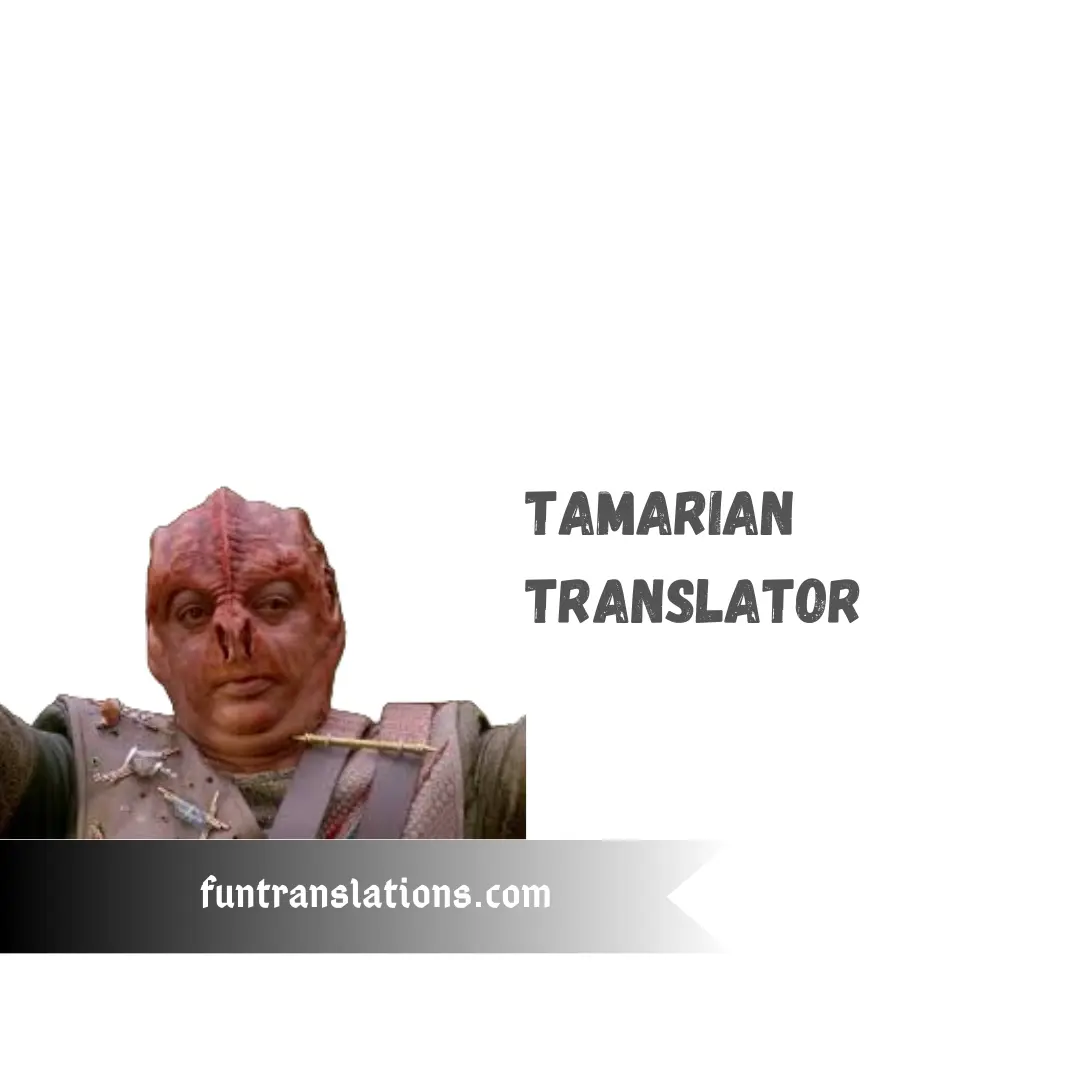
The Cardassians first appeared in Star Trek: The Next Generation and became central antagonists and complex characters throughout Star Trek: Deep Space Nine (1993–1999). Set aboard a captured Cardassian space station, DS9 gave the Cardassian culture — their rigid society, their intelligence service (the Obsidian Order), and their philosophy of duty — far more depth than any other Trek series.
Characters such as Gul Dukat, Garak (a plain, simple tailor), and Damar made Cardassian culture fascinating to explore. Their language reflects their values: duty (perr), truth (so'cil), and loyalty (hezem) are precisely defined, while concepts like vengeance (akem) and intelligence (peren) have their own dedicated words.
Common Kardasi Phrases
| English | Kardasi |
|---|---|
| Hello | salmakt |
| Goodbye | ThIjuk |
| Thank you | turessin |
| Yes | diTh |
| No | yaq |
| I (first person) | nu |
| You | ka |
| Good | vess |
| Duty / Service | perr |
| It is my duty / You're welcome | nu perrik'I |
| Truth | so'cil |
| Peace | loGret |
| Vengeance | akem |
| Victory | bokter |
| Strength (physical) | lo'neUnt |
| Memory / Life | ol'lo |
| Forgiveness | wuTh |
| No surrender | bak'rikan |
| Translator | temes'kasin |
| Cardassia | Kardasia |
Cardassian Culture and the Obsidian Order
Cardassian society is built on rigid hierarchy, state loyalty, and a deep reverence for family. The Obsidian Order — their feared intelligence service — is reflected in the language itself: the word for intelligence (peren) specifically refers to activities carried out by the state, and the word for conspiracy (dakilom) is its own distinct concept.
Cardassians place great importance on rank (kairhailo), duty (perr), and the concept of memory (ol'lo) — the latter used for both the living memory of a person and their life as a whole. Their iconic neck ridges, called neck ridge (kinat'hU), and facial scale patterns are mirrored in the language's precise anatomical vocabulary, with dedicated words for the collarbone (Theniaz), forehead ridge (trot), and chin ridge (ojo).
The strategy board game Kotra (kotra) is a cultural touchstone on Cardassia, representing the Cardassian love of complex, layered thinking — much like their political manoeuvring in the series.
How This Kardasi Translator Works
This translator uses the canonical English-Kardasi Dictionary v0.6.1 by Vyc and tinsnip — the most comprehensive publicly available Kardasi lexicon — which contains over 300 vocabulary entries covering everyday nouns, verbs, adjectives, body parts, foods, military ranks, and Cardassian-specific concepts.
When a word has a direct match in the dictionary, the exact Kardasi translation is used. For words not yet in the dictionary, the translator applies authentic Kardasi phonological rules: digraphs like th become Th, ch becomes Ch, English f and w shift to v (as Kardasi lacks those phonemes), and longer words receive apostrophe-marked syllable breaks and characteristic Kardasi suffixes. A public API is also available for developers wishing to integrate the translator into their own applications — turessin!