Hieroglyphics Translator
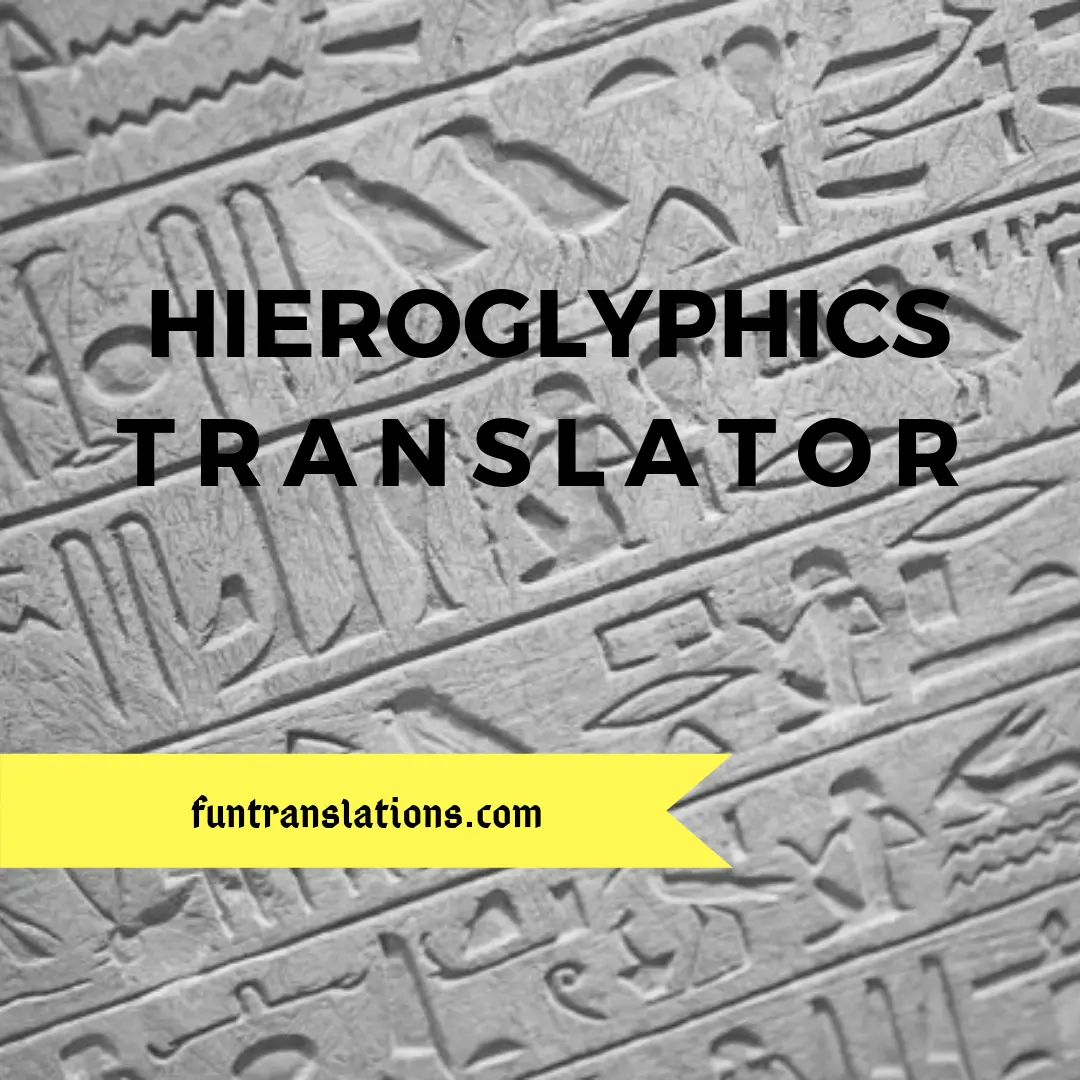
Egyptian hieroglyphs were the formal writing system used in Ancient Egypt. It combined logographic, syllabic and alphabetic elements, with a total of some 1,000 distinct characters.The later hieratic and demotic Egyptian scripts were derived from hieroglyphic writing. Our translator does a transliteration (phonic) of the given text and tries its best to convert to authentic looking hieroglyphics.
This translator works based on custom fonts served from the internet (@font-face). When you copy and paste unless you have the font installed locally on your system, it won't look the same. You can use the image for sharing which will look the same regardless.
Enter some text and click Translate to see the result
What Are Egyptian Hieroglyphics?
Egyptian hieroglyphics are one of the oldest writing systems in human history — a formal script used by the ancient Egyptians for over 3,000 years, from approximately 3200 BCE to 400 CE. The word "hieroglyphic" comes from the Greek hieros (sacred) and glyphein (to carve), reflecting the Egyptian use of this script in sacred and monumental contexts: temple walls, tombs, obelisks, and royal inscriptions.
The system uses pictographic symbols — images of people, animals, objects, and abstract symbols — that can function as logograms (representing whole words), phonograms (representing sounds), or determinatives (unpronounced classifiers that clarify meaning). A single hieroglyphic text might use all three functions simultaneously, making it one of the most complex writing systems ever developed.
The Rosetta Stone — Decipherment
For nearly 1,400 years after the last hieroglyphic inscription was carved, the script was completely unreadable — its meaning lost entirely. The key to decipherment came in 1799 when French soldiers excavating in Rosetta (Rashid), Egypt, unearthed the Rosetta Stone: a granodiorite stele inscribed with the same priestly decree in three scripts — hieroglyphics, Demotic, and Greek.
Since scholars could read the Greek text, they could work backwards. The critical breakthrough came in 1822 when French scholar Jean-François Champollion — building on earlier work by Thomas Young — recognised that hieroglyphics were not purely symbolic but encoded the sounds of the Egyptian language. Champollion's decipherment opened a window into 3,000 years of ancient Egyptian civilisation that had been sealed shut. The Rosetta Stone is now in the British Museum.
How Hieroglyphics Work
Hieroglyphics could be written left to right, right to left, or top to bottom — the direction of the human and animal figures indicates which way to read. Here are some common hieroglyphic symbols and their meanings:
| Symbol | Meaning / Sound |
|---|---|
| 𓀀 (seated man) | Determinative for a man or male person |
| 𓂀 (eye) | Sound "ir" or logogram for "eye/to see" |
| 𓃭 (lion) | Sound "l" (reclining lion) |
| 𓄿 (Egyptian vulture) | Sound "a" (aleph) |
| 𓇳 (sun disc) | Logogram for Ra (sun god) or "day" |
| 𓉐 (house plan) | Sound "p" (per = house) |
| 𓎛 (horned viper) | Sound "f" |
| 𓏤 (stroke mark) | Determinative: indicates preceding symbol is logographic |
Ancient Egyptian Civilisation
Hieroglyphics were the formal script of one of history's greatest civilisations — ancient Egypt, which flourished along the Nile for over three millennia. The script was used to record religious texts (such as the Book of the Dead and the Pyramid Texts), royal decrees, administrative records, and the stories of pharaohs and gods. Major figures like Ramesses II, Cleopatra VII, and Tutankhamun have left hieroglyphic inscriptions that we can still read today.
Hieroglyphics were primarily the domain of trained scribes — a professional class who underwent years of education. Everyday Egyptians used simplified scripts: Hieratic (a cursive form used on papyrus from the Old Kingdom onwards) and later Demotic (a faster, even more abbreviated script for administrative and commercial use). The formal hieroglyphic script was reserved for monuments and religious contexts throughout Egyptian history.
How This Hieroglyphics Translator Works
This English to hieroglyphics translator converts your text into Egyptian hieroglyphic symbols using the standard phonetic correspondence between the Latin alphabet and the Egyptian uniliteral signs — the hieroglyphics that represent single consonant sounds, equivalent to an alphabet.
Enter any English word or phrase and see it rendered in ancient Egyptian symbols. Perfect for anyone curious about ancient writing systems, history enthusiasts, students of Egyptology, or those who have ever wondered how their name would look carved into a pharaoh's tomb.