Morse Code Translator
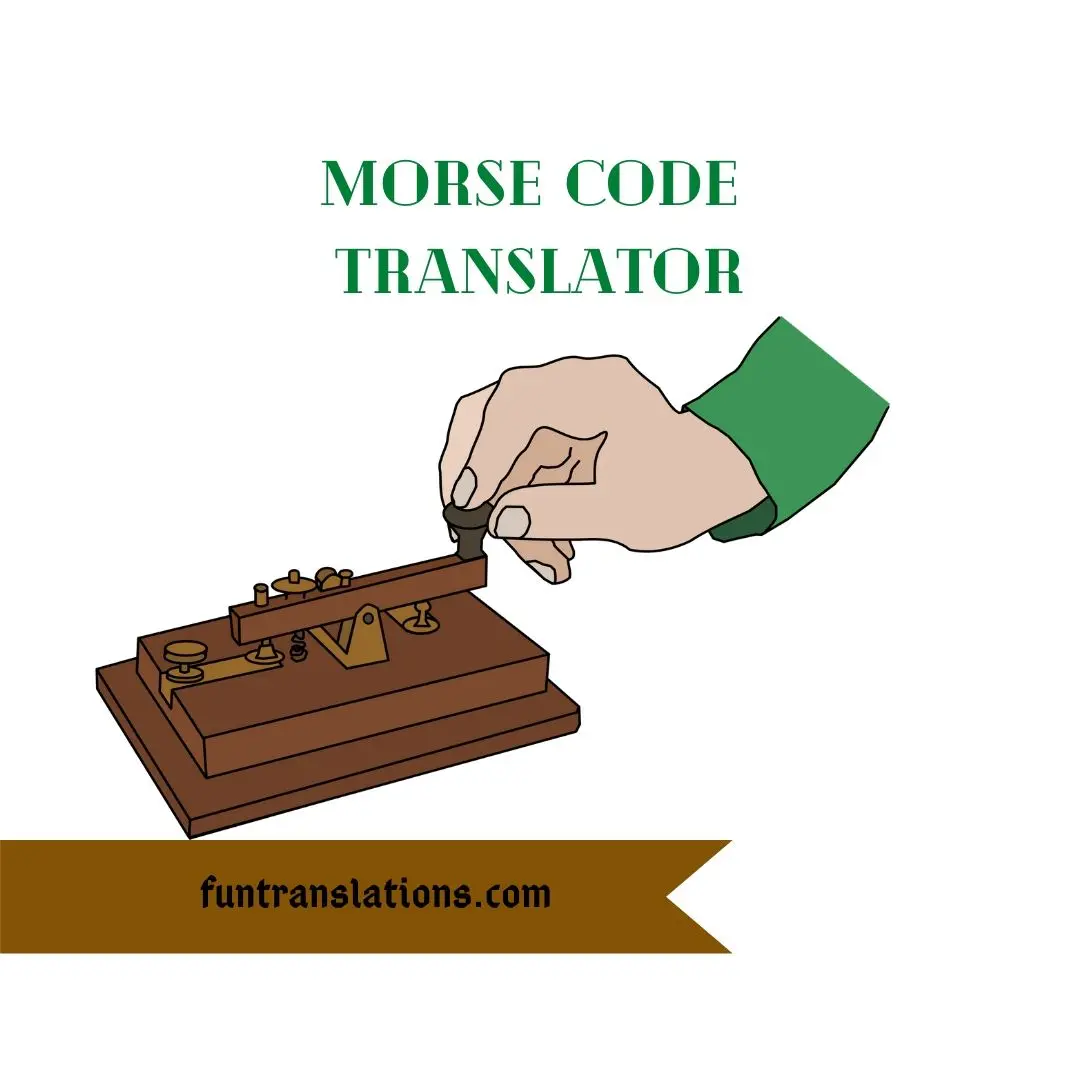
Translate Morse code to English instantly, or convert English to Morse code using the reverse toggle — a free, two-way Morse code translator. Morse code encodes the Latin alphabet, numerals, and punctuation as sequences of dots and dashes used historically over telegraph and radio.
Couldn't load the audio — please try again. Type above and press Play to hear it — no need to translate first. Ready to play. Playing on repeat…
Enter some text and click Translate to see the result
Morse code Translator API Available
Integrate this translator into your app or workflow. Starting at $4.99/month
Morse Code Reference
International Morse Code (Letters & Numbers)
|
A
.-
|
B
-...
|
C
-.-.
|
D
-..
|
E
.
|
F
..-.
|
|
G
--.
|
H
....
|
I
..
|
J
.---
|
K
-.-
|
L
.-..
|
|
M
--
|
N
-.
|
O
---
|
P
.--.
|
Q
--.-
|
R
.-.
|
|
S
...
|
T
-
|
U
..-
|
V
...-
|
W
.--
|
X
-..-
|
|
Y
-.--
|
Z
--..
|
0
-----
|
1
.----
|
2
..---
|
3
...--
|
|
4
....-
|
5
.....
|
6
-....
|
7
--...
|
8
---..
|
9
----.
|
What Is Morse to English Decoding?
Morse to English decoding converts Morse code — the system of dots, dashes, and spaces that encode text as patterns of short and long signals — back into readable English text. Where a Morse code encoder converts "Hello" into .... . .-.. .-.. ---, the Morse-to-English decoder reverses the process: given a string of dots and dashes, it identifies each letter's pattern, matches it to the corresponding character, and reconstructs the original message.
Morse code was revolutionary in the 19th century because it allowed text to be transmitted over the telegraph — a technology that could only send simple on/off electrical signals. By encoding each letter as a specific pattern of short signals (dots) and long signals (dashes), Morse and Vail created the first practical system for long-distance digital communication. The receiver would transcribe the dot-dash patterns they heard on their receiver and decode them back to letters — exactly what this tool does automatically.
Samuel Morse and the Telegraph
Samuel Finley Breese Morse (1791–1872) was an American painter turned inventor who, inspired by hearing about electromagnets during a voyage from Europe in 1832, became obsessed with the possibility of electrical telegraphy. Working with inventor Alfred Vail, Morse developed both the telegraph system and the code that bears his name. The first telegraph line, between Washington D.C. and Baltimore, was completed in 1844 — the first message sent was "What hath God wrought," chosen by Annie Ellsworth.
Within decades, telegraph lines crossed continents and oceans. The first transatlantic telegraph cable was completed in 1858 (though it failed quickly) and permanently in 1866. The effect on commerce, journalism, military communication, and everyday life was transformative — the world suddenly had near-instantaneous long-distance communication for the first time in history. Morse code was the language of this transformation.
Morse Code's Enduring Legacy
Morse code has survived the telegraph age that created it. Ham radio operators still use Morse code — it remains the most reliable way to transmit information over radio when signal quality degrades, because the simple on/off pattern can be decoded even when voice transmission becomes unintelligible. The international distress signal SOS (... --- ...) — chosen for its distinctive pattern rather than any literal meaning — remains in maritime and aviation use.
In popular culture, Morse code appears as a code element in films, games, and puzzles — the pattern of dots and dashes is immediately recognisable as "secret message" even to people who cannot read it. Learning Morse code is still a requirement for certain amateur radio licences. The code has also influenced digital communication design: its principle of variable-length encoding (common letters like E and T get short codes; rare letters get longer ones) anticipates modern data compression algorithms.
How This Morse Code Translator Works
This Morse code translator works in both directions. By default it decodes Morse code back into readable English — parsing the dot and dash patterns separated by spaces and slashes, matching each character sequence to its corresponding letter, and reconstructing the complete message from its Morse encoding.
Need to go the other way? Flip the Reverse Translation toggle above to encode English text into Morse code instead. Perfect for amateur radio enthusiasts, puzzle solvers, cryptography fans, or anyone who has a Morse code message to decode or create. Enter your text or dots and dashes, and the translation will be revealed. .- .-.. .-.. / .-. . ...- . .- .-.. . -..