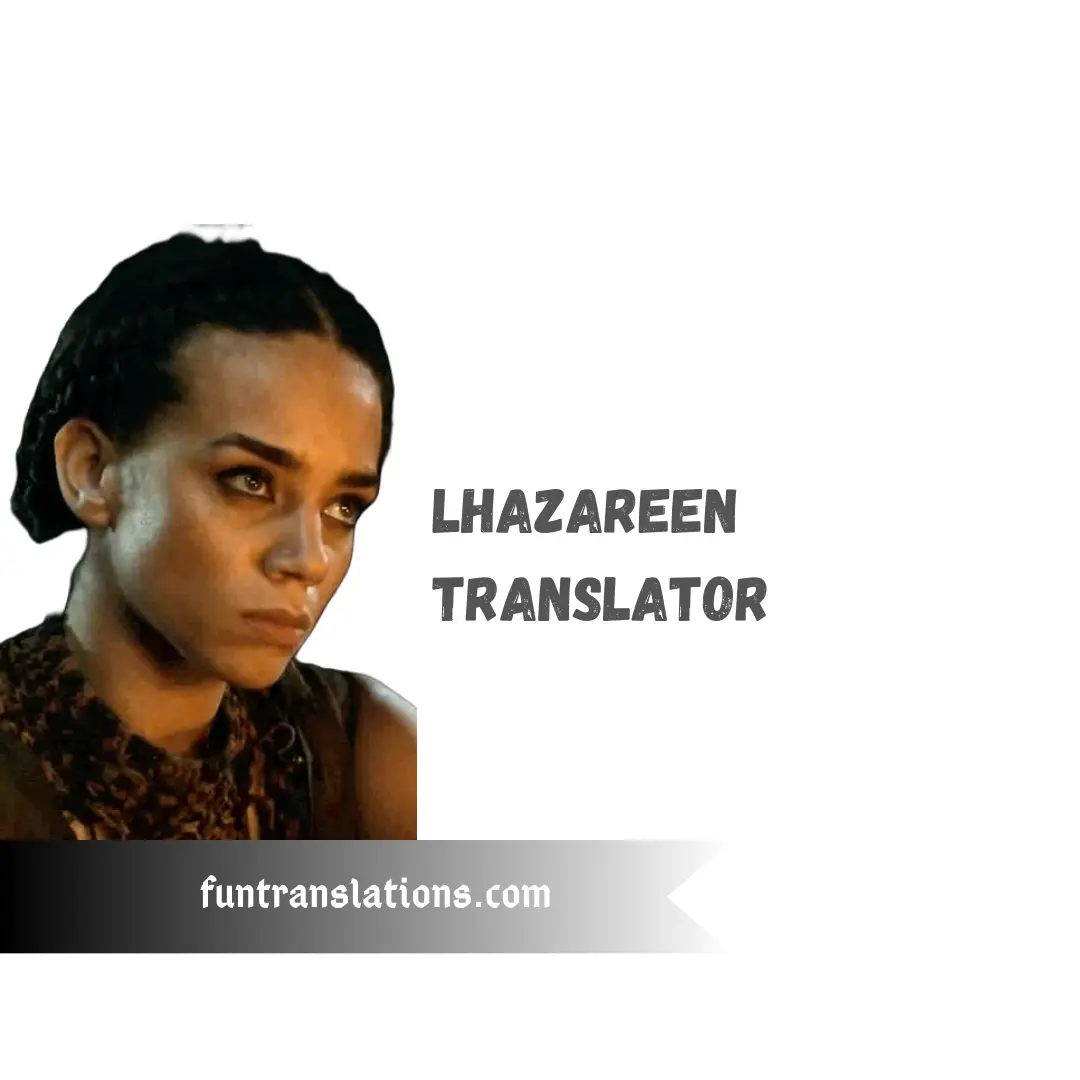
Lhazareen Language Translator — Language of the Lamb Men
Translate English into Lhazareen, the language of the peaceful shepherd people from Game of Thrones. Created by linguist David J. Peterson, Lhazareen features the distinctive lh [ɬ] lateral fricative, umlauted vowels (ö, ü, ä), and aspirated stops (kh, ph, th). Uses Peterson's documented vocabulary and authentic phonological rules.
Enter some text and click Translate to see the result
What Is the Lhazareen Language?
Lhazareen is the language of the Lhazareen people — known across Essos as the "Lamb Men" — peaceful herders and farmers who inhabit the fertile region of the Lhazar, east of the Dothraki Sea. Unlike the thundering Dothraki, the Lhazareen are a settled, non-aggressive people: they raise sheep and goats, tend crops, and live in permanent villages rather than riding in khals.
The language was created by linguist David J. Peterson for HBO's Game of Thrones, the same polymath who constructed Dothraki, High Valyrian, and several other languages across the franchise. Peterson published an official Lhazareen grammar document in 2020, detailing the language's full phonological system, noun class structure, and verb conjugation patterns.
Lhazareen is related to Dothraki — both descended from a Proto-Dothraki ancestor — but the two languages diverged significantly, reflecting the cultural chasm between the nomadic Dothraki and the sedentary Lhazareen.
The Sounds of Lhazareen
Lhazareen has a distinctive phonological signature built around sounds rare in European languages. The most recognizable is lh, which represents a voiceless lateral fricative [ɬ] — the same consonant heard in Welsh ll (as in "Llanfair") and in Zulu. It gives Lhazareen its characteristic breathy, hissing quality.
The language also features aspirated stops (ph, th, kh), the voiced fricatives zh [ʒ] and gh [ɣ], the affricate cluster adz [dz], and umlauted vowels ö, ü, and ä — Germanic-looking spellings that reflect vowels with higher tongue positions than their plain counterparts. This combination creates a sound profile that feels both ancient and immediately distinctive.
Common Lhazareen Words
| Lhazareen | English |
|---|---|
| lhazha | peace |
| lhazim | hello / now / true |
| mirlhim | goodbye |
| bilha | sheep |
| bilhö | lamb |
| bilura | family / home |
| adur | man / chair (attested) |
| lhezi | woman / good |
| birö | child |
| phadir | father |
| lheza | mother / please / she |
| mazhur | death / die |
| zhakur | war / angry |
| lhazur | life / horse / live |
| phezan | mercy / thank you |
| lhezuri | honor / sacred / happy |
| kewir | forest (attested) |
| erilo | crow / bird (attested) |
| adzik | catfish (attested) |
| adzira | turtle / bring (attested) |
| bilé | poppy / flower (attested) |
| ayana | bell (attested) |
| kazga | black (attested) |
| apazh | hot (attested) |
| chak | silent / quiet (attested) |
| sei | yes |
| makh | no |
Words marked "attested" appear directly in David J. Peterson's official Lhazareen grammar document (2020).
Lhazareen Grammar: Structure and Nouns
Peterson's grammar reveals a language of surprising structural depth. Lhazareen nouns are divided into six declension classes — named after example words from each class: adur, adzik, acha, erilo, adzira, and bilé. Each class follows its own patterns for forming plurals, case endings, and nominal derivatives. This noun class system is a typological feature absent from both Dothraki and the other Peterson-built Game of Thrones languages, giving Lhazareen a distinct structural identity.
Verbs conjugate in two major classes (A and B), each with four stem types governing tense and aspect. The language marks present, past, and future tenses as well as positive and negative forms, producing a verb morphology richer than many natural languages of similar geographic scope. Word order is relatively free, with case marking — rather than position — signaling grammatical relationships.
The Lhazareen People in Westeros Lore
In George R.R. Martin's world, the Lhazareen are defined by their refusal of violence. Their cities — Lhazosh, Hesh, and Khosa — sit in the fertile Lhazar region, protected more by their relative poverty than by any military strength. The Dothraki regularly raid Lhazareen settlements for slaves, calling the Lhazareen "haesh rakhi" — Lamb Men — with contempt.
The most prominent Lhazareen character in the series is Mirri Maz Duur, a healer and maegi whom Daenerys rescues from a Dothraki raid. Mirri speaks to the tension at the heart of Lhazareen identity: a people capable of great wisdom and learning, caught between the violent cultures that surround them. Her dialogue — and the language Peterson built for her culture — carries that weight.
How This Lhazareen Translator Works
This translator uses a two-layer approach. The first layer is a vocabulary dictionary built from David J. Peterson's documented grammar examples — attested words like kewir (forest), erilo (crow), adzira (turtle), bilé (poppy), ayana (bell), and adjectives like kazga (black), apazh (hot), and chak (silent). These core words are preserved exactly as Peterson specified.
The second layer handles words not in the dictionary by applying Lhazareen phonological transformation rules: the English th becomes the Lhazareen lh [ɬ], v and j become zh [ʒ], ch becomes the aspirated kh, and common suffixes are replaced with Lhazareen equivalents (-ing → -ira, -tion → -azha, -ed → -ö). The result is an output that sounds plausibly Lhazareen even for concepts Peterson never documented.
The translator is also available via the FunTranslations API for programmatic access. For a full list of supported languages and endpoints, see the API documentation.
Lhazha e bilura. — Peace to your family.