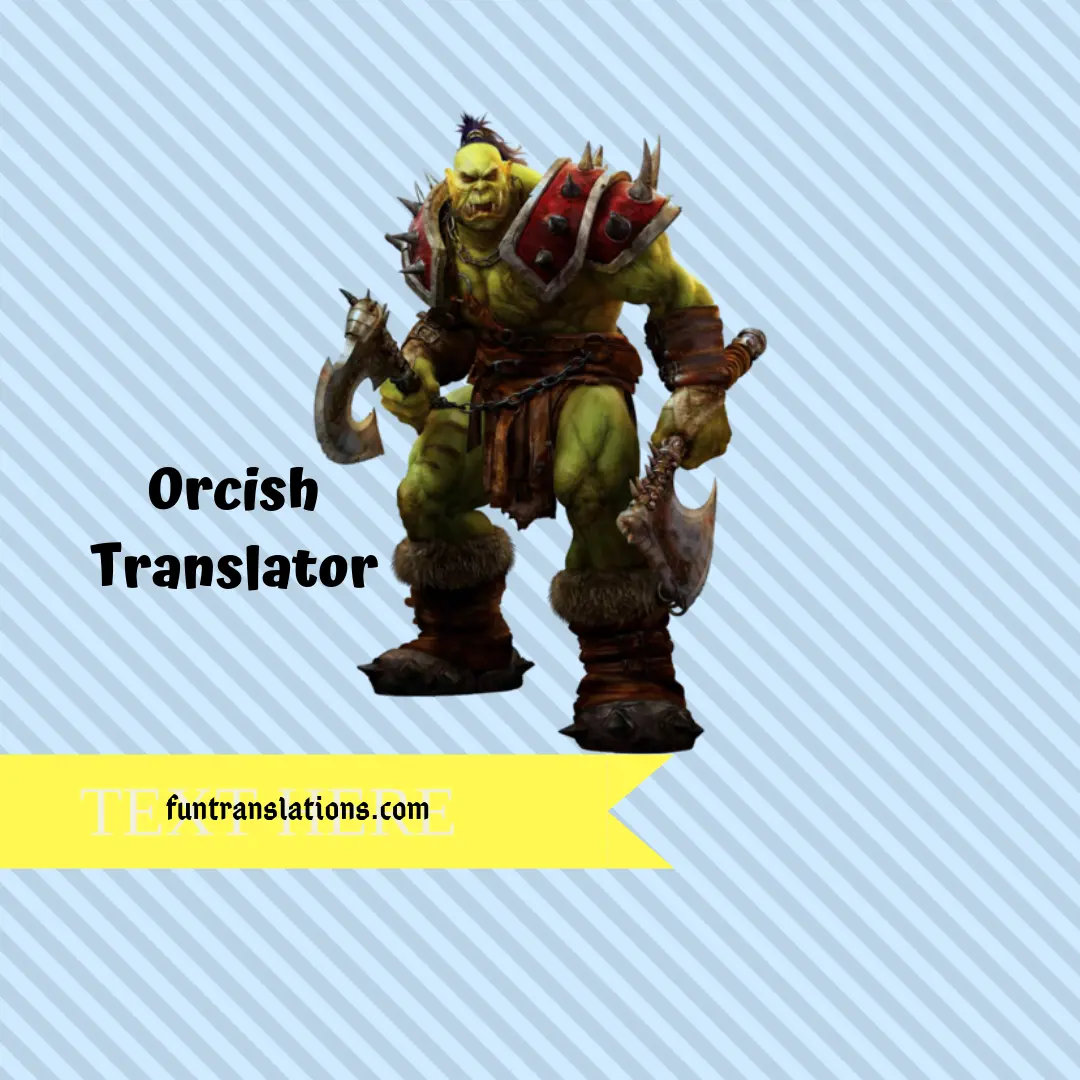
Orcish translator
Convert from English to Orcish. Orcs are fictional humanoids based on many pre-existing mythology. Their popularity is partly because of the references from The Lord of the Rings, Dungeons & Dragons, Warhammer and Warcraft. Our Orcish translator is little inclusive and tries to include as many vocabularies as possible from variety of soures.
Enter some text and click Translate to see the result
Orcish Translator API Available
Integrate this translator into your app or workflow. Starting at $4.99/month
What Is Orcish?
Orcish — or Orc language — refers to the various guttural, aggressive tongues spoken by Orcs across the major fantasy universes: The Lord of the Rings, Dungeons & Dragons, Warcraft, Warhammer, and their many descendants. While each universe has its own version of Orcish, the languages share a family resemblance: harsh consonant clusters, minimal vowels, aggressive cadence, and a vocabulary that prioritises combat, strength, clan loyalty, and dominance. Orcish sounds the way Orcs look — brutal, direct, and devoid of unnecessary complexity.
Tolkien's Orcs — debased and corrupted Elves twisted by Morgoth — spoke a variety of languages including Black Speech (Sauron's imposed tongue) and various tribal dialects. D&D's Orcs have their own language with documented vocabulary in sourcebooks. Warcraft's Orcs speak Orcish, a developed language with unique script. Each version reflects its universe's mythology, but all share the core characteristic of a language designed for a species that values strength and direct action above all.
Orcs Across Fantasy
Orcs are among the most versatile and culturally rich creatures in fantasy literature — a species that has been reimagined in fundamentally different ways across different universes. Tolkien's Orcs are irredeemably corrupted, incapable of creation, serving evil out of fear and hate. D&D's Orcs range from brutal savages to complex tribal societies with honour codes. Warcraft's Orcs are the game's most developed non-human civilisation — shamanistic, noble, betrayed by demonic corruption but capable of redemption under leaders like Thrall.
The evolution of Orcs as a fantasy creature mirrors changing attitudes toward representation in fantasy fiction. Where early fantasy Orcs were often coded as purely evil, modern fantasy — influenced by Warcraft, Dragon Age, The Witcher, and many others — tends to depict Orcs with complex cultures, meaningful histories, and moral agency. The language of Orcs has evolved in parallel: from growling incomprehensibility to fully developed tongues with grammar, poetry, and the capacity to express love, grief, and philosophy.
Orcish Vocabulary Across Universes
Common Orcish words and phrases from major fantasy franchises:
| Orcish | English / Notes |
|---|---|
| Lok'tar Ogar! | Victory or death! (Warcraft Orcish battle cry) |
| Zug zug | Understood / okay (Warcraft Orc acknowledgement) |
| Dabu | I obey / I will comply (Warcraft) |
| Grond | Power / club (Tolkien Black Speech) |
| Gashnak | An Orc name meaning "death-hand" (Tolkien tradition) |
| Skai | Powerful one (D&D Orcish) |
| Uruk | Orc (Black Speech); the Uruk-hai are "Orc-host" |
| Losh | Troll (Elder Scrolls Orcish adjacent) |
The Orcish Honour Code
Many Orcish cultures across fantasy universes share a concept of honour — a code of conduct that emphasises strength, directness, keeping one's word, and dying well in battle. This honour code is expressed in Orcish language through vocabulary that distinguishes clearly between honourable and dishonourable actions, between worthy enemies and cowardly ones, between battle-worthy death and shameful survival.
In Elder Scrolls' Skyrim, the Orsimer (Orc) strongholds operate on a strict code of Code of Malacath — the Daedric Prince venerated by most Orcs — and visitors must prove themselves strong to be welcomed. In Warcraft, the Orc concept of honor (honour) is central to Horde identity under Thrall's leadership, separating his redeemed Orcs from the corruption of the old Horde.
How This Orcish Translator Works
This Orcish translator takes an inclusive approach — drawing vocabulary from multiple Orcish traditions across major fantasy universes to produce authentic-sounding Orcish speech. Enter any English text and get the Orcish equivalent, delivered with the directness and force that characterises all Orcish tongues.
Perfect for D&D players, Warcraft veterans, Tolkien fans, tabletop roleplayers, or anyone who wants to say something with the maximum possible force and minimum unnecessary syllables. Lok'tar Ogar!