Quenya translator
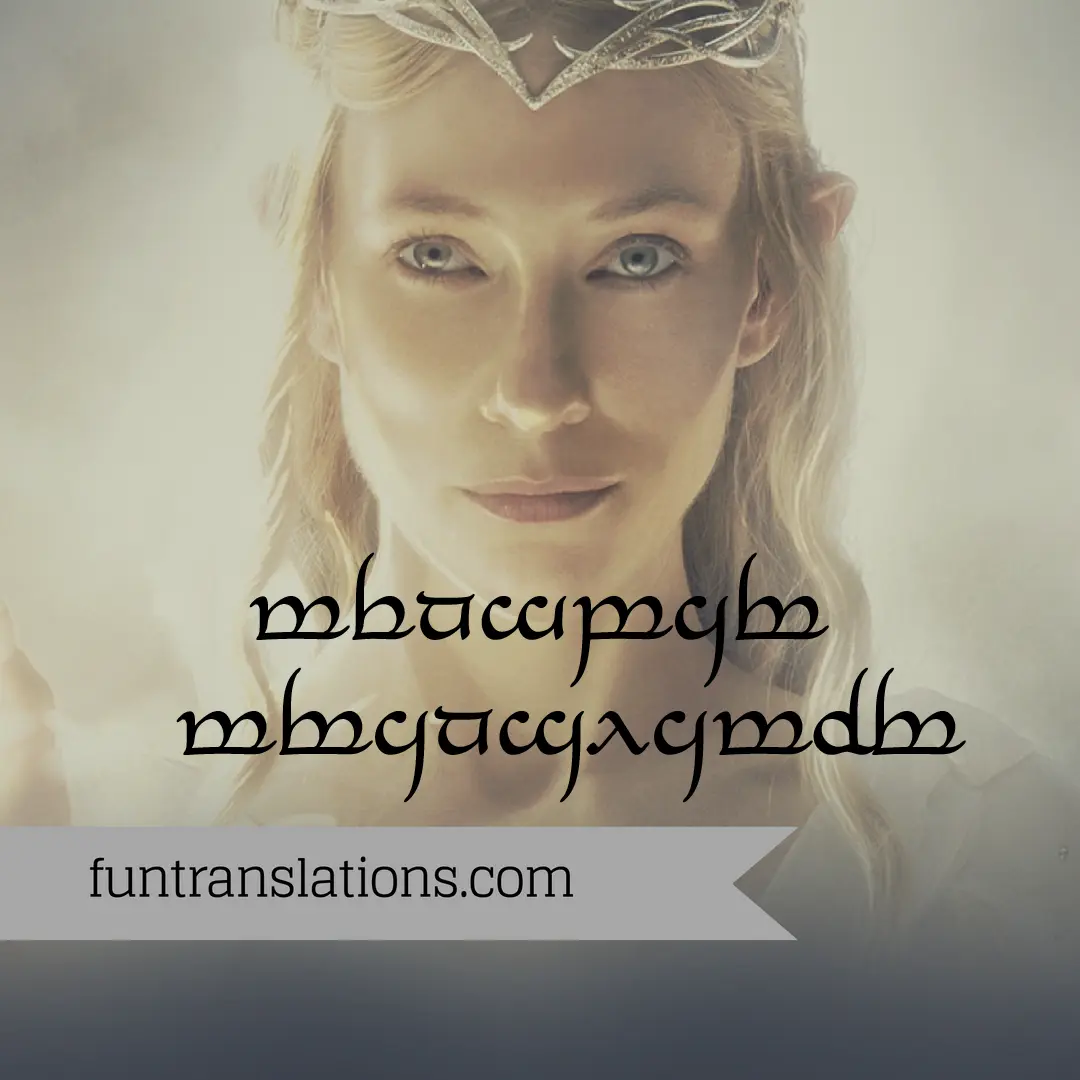
Convert from English to Quenya. Quenya is one of the many languages spoken by immortal Elves. J.R.R. Tolkien created this fictional Elvish language (which uses Tengwar writing system) for the novel Lord of The Rings.
Enter some text and click Translate to see the result
Quenya Translator API Available
Integrate this translator into your app or workflow. Starting at $4.99/month
What Is Quenya?
Quenya is one of the two major Elvish languages created by J.R.R. Tolkien for his Middle-earth mythology. Known as the High Elvish or Ancient Tongue, Quenya was the ceremonial and literary language of the Eldar — the High Elves who dwelt in Valinor. In Middle-earth by the Third Age (the time of The Lord of the Rings), Quenya was a scholarly language used primarily in song, lore, and formal ceremony, much as Latin was used in medieval Europe.
Tolkien was a professional philologist at Oxford University and brought deep linguistic scholarship to Quenya. The language has a complete grammar, extensive vocabulary, multiple writing systems (including the Tengwar script), and a documented history of change across fictional millennia. Quenya draws on Finnish as its primary phonological inspiration, giving it a flowing, melodic quality distinct from the more Welsh-influenced Sindarin.
Quenya vs Sindarin — The Two Elvish Languages
Tolkien created two major Elvish languages. Quenya is the High Elvish of the ancient West — formal, literary, and associated with the Noldor and Vanyar Elves who lived in Valinor. Sindarin is the everyday Elvish of Middle-earth — more fluid, spoken by the Grey Elves (Sindar) who remained in Middle-earth and became the dominant Elvish tongue by the Third Age. Most Elvish dialogue in Peter Jackson's films is Sindarin.
The most famous Quenya passages in The Lord of the Rings appear in Galadriel's speech and Elvish songs. Sindarin appears more conversationally — including the name Legolas ("Greenleaf") and place names like Lothlórien. Both languages use the Tengwar writing system, which Tolkien designed to be written with a calligraphic pen and appears throughout the books and in the films' prop inscriptions.
Common Quenya Phrases and Words
Here are well-known Quenya words and phrases from Tolkien's works:
| Quenya | English |
|---|---|
| Namárië | Farewell (the longest Elvish poem in LOTR) |
| Elen síla lúmenn' omentielvo | A star shines on the hour of our meeting |
| Aiya Eärendil elenion ancalima! | Hail Eärendil, brightest of stars! |
| Utúlie'n aurë! | The day has come! |
| Eldar | Elves (the High People) |
| Calma | Light / lamp |
| Valar | The Powers / angelic beings of Arda |
| Mára | Good |
Tolkien as a Linguist
Tolkien famously said that his mythology was created to give his invented languages a world to live in — not the other way around. He began developing Quenya (originally called Qenya) around 1910, drawing on Finnish, Latin, and Greek. By the time The Lord of the Rings was published in 1954–55, Quenya had decades of development behind it — with internal histories of sound change, dialect variation, and grammatical evolution spanning fictional ages.
The study of Tolkien's languages — called Tolkienian linguistics or Elvish studies — has become a serious academic pursuit. Journals like Vinyar Tengwar and Parma Eldalamberon publish posthumous Tolkien manuscripts analysing his evolving linguistic work. Several universities offer courses on Tolkien's languages, and the online community of Elvish scholars is vast, dedicated, and deeply knowledgeable.
How This Quenya Translator Works
This English to Quenya translator converts your input using documented Quenya vocabulary from Tolkien's published works and posthumous notes compiled by scholars. Enter any English word or phrase and see the Quenya equivalent. Words without direct matches use phonetic and semantic approximations based on known Quenya roots and derivational patterns.
Whether you want to write a message in Elvish, explore Tolkien's remarkable linguistic creation, or find the Quenya version of your own name, this translator gives you a window into one of the most carefully crafted fictional languages in literary history. Namárië!
More Elvish Translators
- English to Elvish Translator (Sindarin & Quenya)
- Sindarin translator
- Tengwar Translator
- Tel'Quessir Elvish Language Translator — Forgotten Realms